



In today’s fast-paced digital world, businesses need more than traditional marketing to stand out. This is where growth marketing comes in—a strategy designed not just to attract customers but to accelerate sustainable business growth. But what exactly is growth marketing, and why is it more than just a trendy term?
What Is Growth Marketing?

Growth marketing is a data-driven, customer-centric approach that focuses on optimizing the entire marketing funnel—from awareness to retention. Unlike traditional marketing, which often prioritizes brand awareness or short-term campaigns, growth marketing is all about experimenting, measuring, and scaling what works to maximize revenue and customer engagement.
For small and mid-sized businesses, growth marketing is particularly valuable because it allows them to compete with bigger players by focusing on cost-effective strategies that deliver measurable results.
What Is a Growth Market?
A growth market refers to a segment or industry experiencing rapid expansion in demand. In such markets, businesses have opportunities to acquire new customers and scale quickly. For marketers, understanding which markets are growing helps prioritize resources, target the right audience, and implement growth marketing strategies effectively.
How Growth Marketing Differs from Traditional Marketing

Traditional marketing often focuses on one-time campaigns or brand promotion, with success measured by reach or impressions. Growth marketing, however:
- Prioritizes the full customer journey, including retention and upselling.
- Relies heavily on data and analytics to test ideas and optimize performance.
- Uses experimentation (A/B testing, multivariate testing) to discover what drives growth.
- Focuses on ROI and measurable outcomes, not just awareness.
For example, a traditional campaign might run a seasonal ad to attract new customers, whereas a growth marketing campaign would analyze user behavior, personalize offers, and optimize conversions throughout the customer journey.
The Role of Growth Marketing in Business
The role of growth marketing is to create scalable growth opportunities by combining marketing, product, and analytics. Key benefits include:
- Customer Acquisition: Attracting the right audience efficiently.
- Retention and Loyalty: Keeping customers engaged with personalized strategies.
- Revenue Optimization: Using experiments to improve conversion rates.
- Data-Driven Decisions: Minimizing wasted marketing spend through analysis.
For example, a small business can implement email nurture campaigns, referral programs, and retargeting ads as part of growth marketing to maximize revenue without increasing budget.
Basics of Growth Marketing
Growth marketing relies on several fundamental principles:
- Customer-Centric Mindset: Understand the audience deeply, including needs and pain points.
- Data-Driven Approach: Use analytics tools to track performance and make decisions.
- Continuous Experimentation: Test different channels, messaging, and offers to find what works.
- Full-Funnel Optimization: Focus on every stage of the customer journey, not just acquisition.
- Scalability: Implement strategies that can grow with your business.
4 Key Growth Marketing Strategies
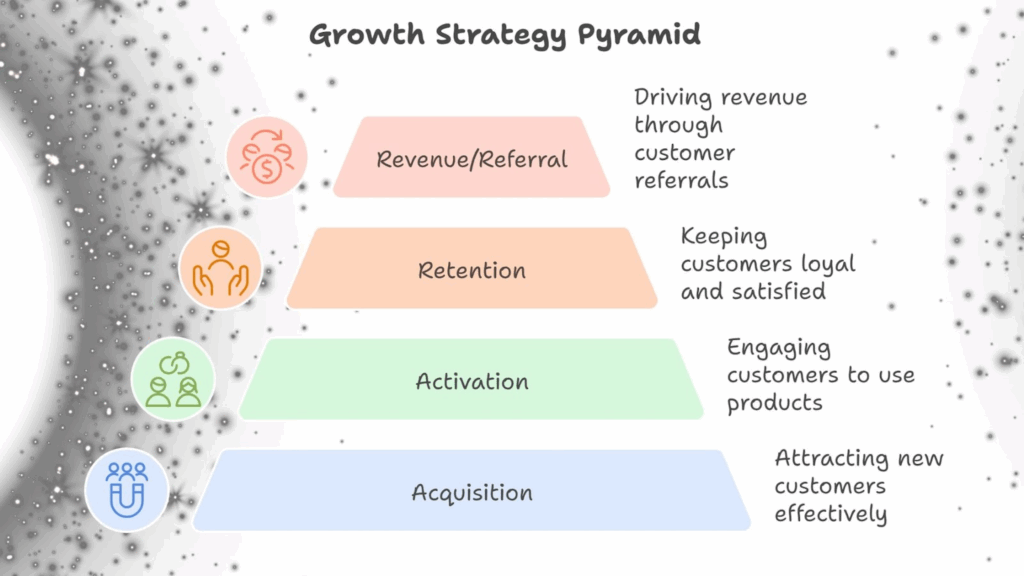
Implementing growth marketing effectively requires a strategic approach. Here are the four main strategies:
- Acquisition Marketing: Bringing new users to your brand using paid ads, SEO, or partnerships.
- Activation Marketing: Ensuring new users engage meaningfully with your product or service.
- Retention Marketing: Keeping customers engaged through personalized experiences and loyalty programs.
- Revenue and Referral Marketing: Maximizing customer lifetime value and encouraging word-of-mouth referrals.
For actionable guidance, check Veloz Marketing’s digital marketing services to see how these strategies can be applied to small and mid-sized businesses.
Growth Marketing Tactics for Small and Mid-Sized Businesses
Growth marketing is highly practical for smaller businesses because it emphasizes experimentation over budget. Some proven tactics include:
- A/B Testing Landing Pages: Improve conversions by testing headlines, CTAs, and layouts.
- Email Drip Campaigns: Nurture leads and encourage repeat purchases.
- Referral Programs: Incentivize existing customers to bring new ones.
- Social Media Retargeting: Re-engage visitors who didn’t convert initially.
- Content Marketing: Publish valuable resources that attract and retain users. Check out our content marketing solutions for examples.
Measuring Growth Marketing Success
Key metrics include:
- Customer Acquisition Cost (CAC)
- Customer Lifetime Value (CLV)
- Conversion Rate
- Retention Rate
- Revenue Growth
By tracking these KPIs, small and mid-sized businesses can optimize campaigns and scale efforts without overspending.
Seasonal Trends and Growth Marketing

Seasonal trends can heavily impact marketing effectiveness. Growth marketers analyze historical data to:
- Identify peak periods for sales or engagement.
- Adjust promotions and campaigns according to trends.
- Experiment with timing, messaging, and channels to maximize ROI.
For example, the holiday season often sees high engagement with email campaigns, retargeting ads, and limited-time offers. Learn more about effective social media campaigns for peak seasons.
Why Growth Marketing Is Not Just a Buzzword

Growth marketing combines strategy, analytics, and creativity. Unlike buzzwords that fade, growth marketing delivers real results for businesses willing to adopt a data-driven mindset.
It helps small and mid-sized businesses:
- Reduce wasted marketing spend.
- Make informed decisions based on real customer data.
- Scale campaigns intelligently for long-term growth.
In short, growth marketing is practical, measurable, and essential for businesses that want to compete in today’s market.